Leveraging the Power of Asynchrony in ASP.NET

Asynchronous programming has had a lot of attention in the last couple of years and there are two key reasons for this: First it helps in providing a better user experience by not blocking the UI thread which avoids the hanging of the UI screen until the processing is done and second, it helps in scaling up the system drastically without adding any extra hardware.

But writing asynchronous code and managing the thread gracefully was a tedious task. But as the benefits are tremendous.. Read complete post on Infragistics blog

User Name availability check with AngularJS, ASP.NET MVC and ASP.NET Web API


User Name availability check is required in most of the registration forms where we allow user to choose a user name that one can use to login later. In some other scenarios, we allow user to use his/her email as login id/user name. In both the scenarios, we require to make sure that user name or email is not used earlier. In this post, I am going to discuss, how to achieve this feature in an application which is developed using AngularJS, ASP.NET MVC and ASP.NET Web API. I wont discuss in detail the Data Access part, where one can use any approach like Entity Framework, Identity Framework , Membership provider or ADO.NET.

In this post, we will create an empty ASP.NET project with MVC and Web API. We’ll start working on Web API  part where an API will be exposed which will take user’s entry for user name as input and return true and false based on its existence. After that we will work on MVC part where we will create a registration form where user will put its information. In last, we will focus on AngularJS and create the basic infrastructure including a Service which will call the Web API to check the user name existence then how will do the check on view we will discuss at later section.

I created an API folder under Controller and created an empty Web API controller (RegistrationController) which exposed an API IsUserNameAvailable which takes an username and returns true if available else returns false. It is as

  [RoutePrefix("api/Register")]
    public class RegistrationController : ApiController
    {
        [Route("IsUserNameAvailable")]
        [HttpGet]
        public bool IsUserNameAvailable(string userName)
        {
            IRepository rep = new SQLRepository();
            IList<UserAccount> users = rep.GetUser(userName);
            return users.Count == 0;
        }
    }


Inside the API, I have used a SQLRepository which connects to the database and returns a list of users based on it. If there is no match then list contains no items. Let’s have a look that our table in database form where the account is getting matched.

table

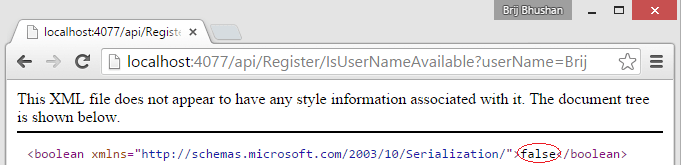
Now let’s just quickly check that whether our API is working properly. The simplest way to check any API Get request via browsing the URL itself. So let’s check the URL

http://localhost:4077/api/Register/IsUserNameAvailable?userName=Brij

So as we see that Brij exists in the database so it returns false.
WebAPIResult

Now let’s create an empty MVC controller (UserRegistrationController) and View for the Index action which has an input control to enter the username.

Now its time to introduce the AngularJS into the application. Let’s see that what all the AngularJS components we need to create to implement the feature.

  1. Angular Module – To bootstrap the application.
  2. Service – This service will connect to exposed Web API to check the user name availability. It will initiate the AJAX (http) call and get the appropriate response accordingly.
  3. Angular Controller- To add some logic
  4. Custom Directive – We will discuss it in later section

I have created a new folder Registration in scripts folder to put all the angular resources. I created an angular module (file name as RegModule) which has currently

var registrationModule = angular.module('registrationModule', []);

Now it time create a service which will connect to the server to check the user availability and return true or false accordingly. I am using Factory method for creating service as

registrationModule.factory("RegService", function ($http, $q) {
    return {
        IsUserNameAvailablle: function (userName) {
            // Get the deferred object
            var deferred = $q.defer();
            // Initiates the AJAX call
            $http({ method: 'GET', url: 'api/Register/IsUserNameAvailable?userName=' + userName }).success(deferred.resolve).error(deferred.reject);
            // Returns the promise - Contains result once request completes
            return deferred.promise;
        }
    }
});

Now to handle the UI part, we have two options

1- Either we do all the UI manipulation using Angular controller and add the required code. Or

2- We can create an custom directive where all the logic will be put to check the uniqueness of the username and updating the UI.

Lets quickly see first option, where we will write the logic in Angular Controller  as

    $scope.checkUserAvailable = function () {
        RegService.IsUserNameAvailablle($scope.Registation.username).then(function (userstatus) {
            $scope.registrationForm.username.$setValidity('unique', userstatus);
        }, function () {
            alert('error while checking user from server');
        });
    };

Here we are using $setValidity of for the model and add the unique attribute and set it true/false based on the service response. This will set the validity of the input as true/false and we can show some messages based on that. So let’s see the form


<div class="container" ng-app="registrationModule">

<div class="row" ng-controller="regController">

<form name="registrationForm" role="form">
            <label for="username">User Name:</label>

<div class="form-group">
                <input type="text" name="username" id="username" ng-model="Registation.username" class="form-control" placeholder="Username" ng-blur="checkUserAvailable()" />
                <span class="alert alert-danger" ng-show="registrationForm.username.$dirty && registrationForm.username.$error.unique">
                    User name is not available
                </span>
            </div>

        </form>

    </div>

</div>

We are calling checkUserAvailable function in blur event so that it gets fired when user moves focus from the control after entering the data. We also added a span (p) to show the error message which checks the input control state and unique attribute that we added. Now let’s run the application and see

sample

As Brij is already exists in the database so it is not available and if you enter any other username which is not available in database, it wont show the message.

Second option is much cleaner so we will create a custom directive (I have written 19 posts on AngularJS, you can go here to learn all the topics or for custom directives refer the Part -9 and Part -10)

So let’s create our custom directive. Here it will use the RegService and add an onblur event to the input which will be fired once user goes out of the control after entering the some data as

registrationModule.directive('useravail', ['RegService', function (RegService) {
    var directive = {
        restrict: 'A',
        require: 'ngModel',
        link: function (scope, element, attrs, ngModel) {
            element.on('blur', function (evt) {
         
                if (!ngModel || !element.val()) return;
                var curValue = element.val();

                RegService.IsUserNameAvailablle(curValue)
                .then(function (response) {
                        ngModel.$setValidity('unique', response);
                }, function () {
                    //If there is an error while executing AJAX
                    ngModel.$setValidity('unique', true);
                });
            });
        }
    }
    return directive;
}]);

Here we have used similar code that we wrote in angular controller. Here we added blur event to the input control in directive. So let’s see the form


<div class="container" ng-app="registrationModule">

<div class="row">

<form name="registrationForm" role="form">
            <label for="username">User Name:</label>

<div class="form-group">
                <input type="text" name="username" id="username" ng-model="Registation.username" class="form-control" placeholder="Username" useravail />
               // later code is same as first option so removed forbrevity

We have set the ng-model and added our custom directive useravail as an attribute at the end in the input element. When we will run this application, it will have same as first option.
So we have implemented User name check using AngularJS, ASP.NET MVC and Web API. We can change the look n feel based on our need. Complete code is attached with this post.

Cheers
Brij

Getting started with Unit Testing in {{AngularJS}} – Part 19

Unit Testing one of the important activities in software development. It helps in reducing the number of bugs in the code and maintaining the code quality. As now a days we work on small releases and keep adding/updating features, Unit Test plays a vital role in maintaining the quality and helps in making sure that new changes does not break earlier functionality and reduces the testing effort. Unit Test becomes more important for languages like JavaScript because it is loosely typed and we don’t find issues until we run the functionality. Also testing and debugging JavaScript is another time consuming activity.

Note – This post is a part of series of posts on AngularJS and it is 19th one. Click here to view all the post. Apart from that you can also use the navigation links for next and previous post in each post at the bottom to check all.

What is Unit Testing

Unit Test is a snippet of code or function which tests a unit of code (function/API) and all the required dependencies are mocked. It means it just test the business logic written in the function and if any other dependent instance is required then mocked version is used. Unit test does not call any real service, database call etc.

What do we need in AngularJS to get started

Being a .NET developer, I have written thousands of unit tests using C# and Visual Studio. You might be knowing that to create and run an unit test, we require unit test framework where we can run our unit test (like NUnit, MSTest etc), Unit test APIs , Mocking framework  (like NMock, Rhino mock) and then these tests can be part of Continuous Integration system where we can run the unit tests on every check-in to the repository. Similar infrastructure set up we also need in AngularJS. There are many options but I am going to use the most recommended one’s. Let’s discuss all

  1. Jasmine – It is a behavior driven development framework for testing JavaScript code and preferred for Angular Applications. There are similar others like Qunit that we can use.
  2. Angular- mock – Angular provides its own mocking framework which helps in mocking the dependent objects.
  3. Test Runner –  One of the most used Test-runner in Karma but as we are fond of using Visual Studio, there is another nice test runner called Chutzpah which provides a plugin (Chutzpah Test Adapter) for Visual Studio which is very useful.

We have discussed the required tools. Now let’s set up our environment as

  1. Create a ASP.NET Project (I am starting with empty ASP.NET MVC Project with Unit Tests).
  2. Install Chutzpah Test Adapter plugin via Nuget manager
    chutzpah
  3. Install Jasmine Nuget package.
    Jasmine
  4. Add Angular mock (angular-mocks.js) library for mocking purposes.

Now we have set up our solution. First we will write a simple (addition) method and a unit test to verify the set up. Before writing test let’s understand the following three items which are minimum to write any unit test using Jasmine.

  1. describe – This is a global function that takes string and function as parameter which represents a suite of test. In another way, it provides us a way to group multiple tests.
  2. it – This is another function which is written inside global function and takes two parameter as above string and function and this function is actual test.
  3. expect – It takes the function that need to be tested as parameter and provide a list of matchers to match the result.

Let’s write a JavaScript  function and write unit test for that as

  1. Add a folder in scripts folder (say CustomAngular) and add new JavaScript file say Home.js .
  2. Write a Add function in the Home.js as
    function Add(firstnum, secondnum) {
        return firstnum + secondnum;
    }
    
  3. Add a file Home.test.js in scripts folder of Unit Test project to write our unit tests cases.
  4. It’s time to write our unit test for the same as
    describe("My First Test -&amp;gt; ", function () {
        it("Add with two positive num", function() {
            expect(Add(2, 3)).toEqual(5);
        });
    });
    

So we have written our first test. I already explained the special key words used here. You also need to include the references of Jasmine library and Home.js here. To run this Unit test, we just need to build the solution and open the Test Explorer and run the Unit Test. After running the Unit Test it will show green as

TestExPSampleIt means we have set up our infrastructure correctly. So let’s move to real stuff. First we will create a MVC sample application then write unit test. This application would be similar to which we have created in our series of post. But we will take small steps to understand it better. Our MVC application looks as

ExampleLet’s see code quickly. Our MVC controller (HomeController) has just one Index method which returns a view. Our Index View is as


<h2>Talk Details</h2>


<div class="container">

<div class="row" ng-controller="talkController">

<table class="table table-bordered table-condensed table-hover">

<tr ng-repeat="talk in talks">

<td> {{talk.id}}</td>


<td> {{talk.name}}</td>


<td> {{talk.speaker}}</td>


<td> {{talk.venue}}</td>


<td> {{talk.duration}}</td>

 </tr>

 </table>

 </div>

 </div>

Now let’s see our JavaScript file where we have put up our Angular code

var homeModule = angular.module("homeModule", []);

homeModule.controller("talkController", ['$scope', function ($scope) {

    $scope.talks =  [
        { id: '1001', name: 'Real Time Web Applications with SignalR', speaker: 'Brij Bhushan Mishra', venue: 'Hall 1', duration: '45' },
        { id: '1002', name: 'Power of Node.js', speaker: 'Dhananjay Kumar', venue: 'Hall 2', duration: '75' },
        { id: '1003', name: 'Getting started with AngularJS', speaker: 'Brij Bhushan Mishra', venue: 'Hall 1', duration: '60' },
        { id: '1004', name: 'Microsoft Azure - Your cloud destination', speaker: 'Gaurav mantri', venue: 'Hall 1', duration: '45' }
      ];

}]);

Also I have included Angular library, Home.js and added ng-app attribute as well. Now we will write the unit test for our Angular Controller.

First let’s understand our Angular controller. Here We have a module and a controller which takes one parameter $scope. So while writing test, we require these three items and these need to be initialized first before running the test. To initialize, Jasmine provides us beforeEach function which can be used to initialize the items which runs before the test. And we need Angular mock library to set up all. Let’s see the test and then discuss each

describe("Talk Controller Tests -> ", function () {
    var scope;
    var $ctrlCreator;

    beforeEach(module("homeModule"));
    beforeEach(inject(function ($controller, $rootScope) {
        $ctrlCreator = $controller;
        scope = $rootScope.$new();
    }));


    it("It should have four talks", function () {
        $ctrlCreator("talkController", { $scope: scope });

        expect(scope.talks.length).toBe(4);
    });

});

In the above code snippet, we first created two variables then initialized homeModule after that we injected controller and scope instance with the help of mock. In our Test, we are testing that length of talks returned by our controller is four. Now we can run our unit test via Test Explorer and it will pass. Similarly we can write many more tested for controller’s functions.

Conclusion

In this post, we talked about Unit test in angular. What are the basic things required to set up the project and get it started. Then we created a simple function Add and wrote unit test for that to check the setup. We continued writing the unit test of our controller and saw that how to initialized items before running the test. Hope you have enjoyed the post. In next Post we will continue talking about Unit Testing and write unit tests for some other components.

Cheers,
Brij